
Miami County Tax Record Fields
Value work and billing work live in separate systems. Beacon carries the appraisal side, including class, prior value, and land and improvement facts. The Treasurer search handles the billing side, showing tax type, year, taxpayer role, and whether a balance is current or delinquent. Check the source date beside every number.
| Field | What It Shows | Where |
|---|---|---|
| Appraised value | County estimate as of January 1 | Appraiser and Beacon |
| Assessed value | Taxable portion after the class rate | Appraiser |
| Tax year | Year tied to the statement | Treasurer search |
| Name role | Current owner, taxpayer, or both | Treasurer search |
| Status | Current or taxes due, including delinquent | Treasurer |
Appraised, assessed, tax, and sale figures are not synonyms. A class rate converts appraised value to assessed value. The mill levy then produces the tax, while a deed's consideration remains a separate fact that may not equal current market value.
Search Miami Tax by Type
The Miami County tax search starts with record type. Choices cover real estate, personal property, oil, gas, trucks, minerals, and state-assessed utilities. A house or tract calls for Real Estate. Owner or taxpayer names also work. Beyond that, the form accepts a year range, street fields, ZIP, subdivision, block, lot, and section-township-range. Two checkboxes narrow results to current taxes or statements with taxes due, current or delinquent. Name Match Type separates Current Owner, Taxpayer, and Both. This keeps a billed party from being mistaken for a title holder.
| Search field | Format or choice | Purpose |
|---|---|---|
| Tax Type | RL, PP, OL, GS, TK, MN, SA | Select record family |
| Year range | Starting and ending year | Compare statements |
| Name Match | Owner, taxpayer, both | Keep roles distinct |
| Legal fields | Subdivision, block, lot, STR | Find land without a clean address |
View Miami County Tax Fields
The official Treasurer search form shows every tax-type option plus segmented CAMA entry, owner and taxpayer controls, year fields, and land-description routes. It is the page to open before planning a query.
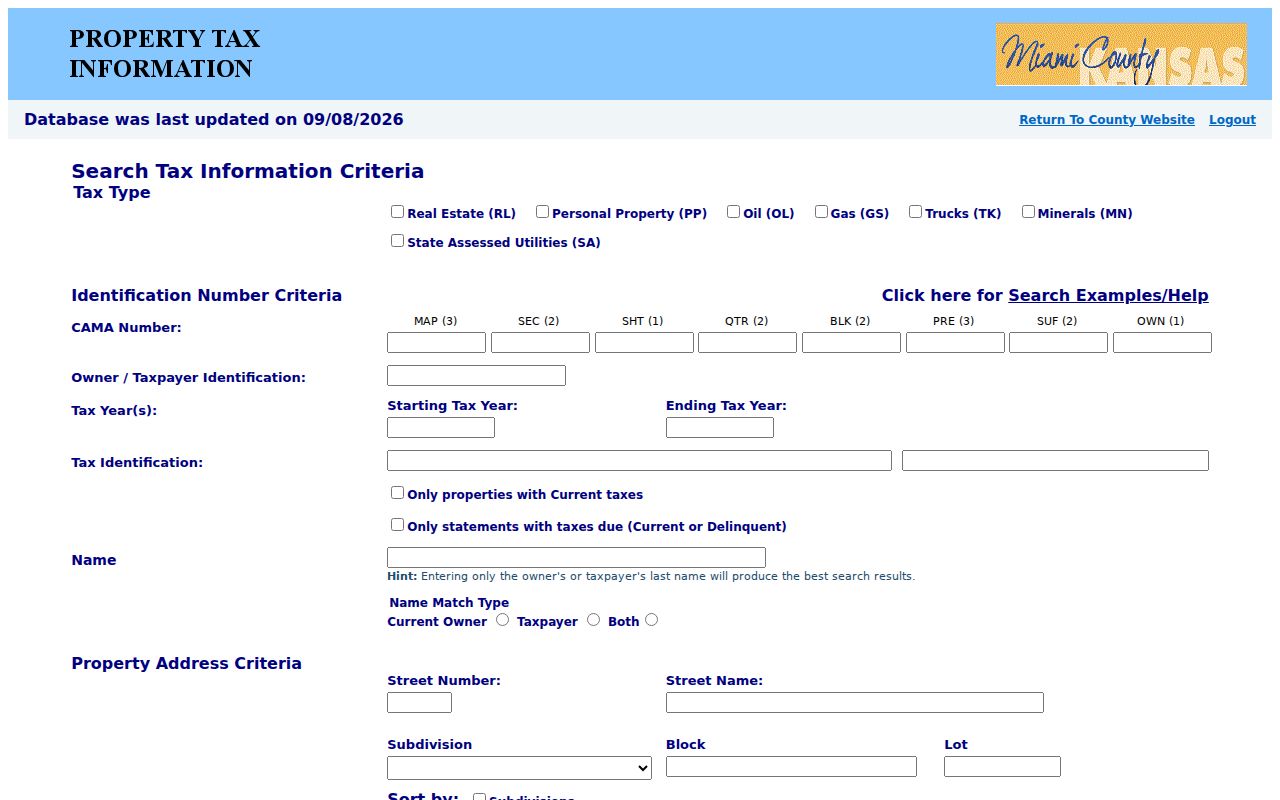
A precise field combination beats a loose name query on this form. Keep the role, year, and due-status filters attached to any result.
Reconcile Miami Tax and Deed
A tax record is not proof of title. The taxpayer may be an escrow agent, former owner, or estate contact, and a fresh deed can post before the roll catches up. Match it against the newest recorded deed.
Delinquency works the same way. A taxes-due flag shows one statement on one date. By itself it does not establish a foreclosure judgment, redemption, sale, or deed. Those events require the tax file, court case, and recorded instruments.
For history, Miami County keeps real-estate tax rolls permanently. The Kansas Historical Society holds tax assessments from 1916 through 1938 in its Miami County collection. Most of that archive is paper or microfilm and needs staff help.
Decode Miami County CAMA
CAMA splits into MAP, SEC, SHT, QTR, BLK, PRE, SUF, and OWN on the tax form. Printed field lengths guide entry. Keep the leading zeroes and the boundaries between segments. This county-specific key is steadier than a postal address. It can bridge a rural tax result to Beacon and then to deed legal-description text.
Do not collapse the segments before verifying the match. If a result disagrees with Beacon, compare tax year, certification date, parcel split history, and the exact legal description first. Only then decide either system is wrong.
Note: Current Owner and Taxpayer are separate Miami County search roles, so keep both labels on saved tax results.
Kansas Rates Shape Miami Taxes
Kansas classifies property before any mill levy applies. Residential property is assessed at 11.5% of appraised value. Commercial and industrial use 25%. Agricultural land uses 30% of use value, vacant lots 12%, not-for-profit property 12%, and public utilities 33%. Other classes follow their statutory rates.
The core formula is simple. Appraised value times the assessment rate gives assessed value; assessed value times the mill levy, divided by 1,000, gives the tax. Agricultural use value is the big exception to market-value thinking. Verify the parcel's class before testing any calculation.
Miami Values Have Dated Trends
A 2025 market study found Miami County residential values rising 6.0% from 2024 to 2025. Commercial climbed 1.7% and vacant land 11.2%. A 2026 study of 35 paired land resales reported a ten-year mean trend of 11.62% and a median of 11.48%.
These are countywide findings, not parcel values. They can explain a sudden change in a notice. Still, the parcel's own class, characteristics, effective date, and comparable evidence control its review. A study percentage is no deadline. It promises no sale price either.
Find a Miami County Bill
Use the parcel or CAMA number when you can, pick Real Estate, and set a clear year range. An address works as a fallback. Check whether the name matched as owner or taxpayer. Save the amount and status with the tax year. Delinquent payment is not available online, so the Treasurer must confirm the payoff.
- Select the correct tax type and enter parcel, CAMA, or address.
- Set the year range and choose the right name-match role.
- Read the statement year, amount, and current or due status.
- Compare the appraisal record and contact the Treasurer about delinquency.
- Assessed value
- The taxable portion produced by the class rate.
- Mill levy
- The rate applied per thousand dollars of assessed value.
- Tax statement
- The Treasurer's bill for a named year and parcel.
- Tax lien
- A government claim arising from unpaid tax.
Miami County Payment Calendar
Miami County runs its tax year on a familiar rhythm. Property is valued on January 1. Appraisal notices usually go out by March 1. Tax statements follow by December 15. Full or first-half payment is then due December 20. The second half is due May 10. When a deadline lands on a weekend or holiday, the dated annual notice from the county controls the shifted date.
The 2025 cycle shows how it works. Statements were mailed November 14. Full or first-half payment was due December 22, 2025. The second half came due May 11, 2026. Treat those figures as one year's example, not a standing rule. Check the Treasurer's current notice each year instead.
Pay Miami County Tax
Paying a Miami County tax bill starts with the county's online route. That route requires statement and KanAccess credentials. The county charges a convenience fee for it. That path does not handle delinquent accounts. The Treasurer should be contacted for the current total and the accepted process on those. Mail works too, using a check, money order, cashier's check, or cash with the coupon.
The county lists the accepted in-person methods. Card payments there carry a $3.95 convenience fee. A drop box sits on the south side of the Administration Building. Confirm the amount and deadline before picking a channel.
Miami County Delinquency Records
Real-estate tax rolls are kept permanently in Miami County. Real estate can go to a tax-foreclosure public auction. The county allows this after three years of delinquency. Its current tax foreclosure page reports no county tax sale scheduled in 2026.
That announcement is not a clean bill of health for any parcel. It does not rule out a delinquent balance, judgment, redemption issue, or prior sale on a specific property record. A delinquent balance could still exist. A judgment, redemption issue, or prior sale could exist too. Check the tax statement, the recorder filings, and any court case before drawing conclusions. A foreclosure exhibit is a litigation snapshot, not proof of current ownership.
Challenge a Miami County Assessment
Under the Miami County appeals process, a taxpayer has 30 days from the notice mailing to file. An informal hearing with the Appraiser can be requested by meeting, telephone, or in person. The office then issues a written decision. Review can continue to the Small Claims Division of the Board of Tax Appeals and then to the Board of Tax Appeals itself.
Equalization and payment under protest are separate routes. The county says both cannot be used for the same year. Save the notice envelope, valuation date, property facts, photos, and comparable evidence before any hearing. The Appraiser's office is at 201 S Pearl, Suite 100, Paola, and lists 913-294-9311.
Appeal window. Miami County allows 30 days from the assessment notice mailing. Use the current notice date and contact the Appraiser promptly.