
Trace Miami County Former Owners Transfer by Transfer
Use each conveyance as a row in a working timeline. The Register of Deeds keeps deeds, mortgages, easements, liens, releases, assignments, plats, and county UCC-related filings. Never treat every indexed instrument as a sale.
| Source | Years It Covers | Where Held | What It Shows |
|---|---|---|---|
| Fidlar Laredo/Tapestry | Online cutoff not publicly stated | Remote recorder access | Grantor/grantee, instrument, date, legal description, available image |
| Historic deed indexes | From 1859 in described KHS series | KHS Reference Room/catalog | Names and references leading to county volumes |
| Land/lots and plats | Historic county series | Recorder, planning, KHS | Subdivision, lot/block, dedication and geography |
| Tax and court series | Within the 1857–1979 KHS collection scope | KHS and courthouse | Dated administrative or estate/court clues |
Fidlar carries the recent deed records. Go back far enough, though, and entries thin out. When an older deed is missing from the online index, turn to recorder staff, the deed books, and the KHS Miami County collection description for archived property records. A gap in the index never proves the transfer failed to happen.
Build a Backward Deed Timeline
| Transfer date | Grantor → grantee | Instrument | Reference |
|---|---|---|---|
| Newest located date | Prior owner → current grantee | Deed type as indexed | Instrument or book/page |
| Earlier acquisition | Earlier owner → prior owner | Read the image; do not infer | Matching legal description |
| Next earlier link | Repeat backward | Note probate or court link | Volume/page or archive lead |
Carry the legal description through every step. A street address works as a modern label, but the tract description is the stronger test of continuity when you trace a parcel across decades of property records.
Walk the Miami County Deed Chain in Reverse
The county's Fidlar plan lays out two doors into the deed index. Laredo suits frequent users. Tapestry works pay-as-you-go, with an $8.75 index and image search and $1 per printed page. Either way, you can run a Miami County property search by grantor, grantee, document number, recording date, or legal description.
- Find the latest conveyance and read the deed image, not only its index row.
- Record its grantor, grantee, date, deed type, legal description, and instrument or book/page.
- Search that grantor as a grantee to locate how the prior owner acquired the same tract.
- Repeat until the online index stops, then request the referenced deed book or historic index.
- Grantor / grantee
- The conveying party and recipient named in an instrument.
- Chain of title
- The ordered sequence of instruments affecting a tract.
- Reverse index
- An index organized for searching one side of the grantor-grantee relationship.
- Quitclaim / warranty deed
- Different conveyance forms whose legal effect must be read from the instrument.
Search Old Subdivision and Street Names
Paola keeps its own memory. The city's archive holds ordinances and planning records for North Ridge Estates, Rockwood Estates, Paola Industrial Park, Paola Crossings, and Hidden Meadows Court. It also keeps annexation and de-annexation files. Run a development name through the Beacon subdivision field, the planning archive, and the recorder's legal-description index as well. No single source catches everything.
A final plat rewards close reading. It can reveal the lot and block sequence, neighboring subdivisions, streets, easements, and dedication language. Family names change over time. Search the plat name before an owner surname when that happened. Then confirm the old name is a recorded subdivision rather than a local label.
Use KHS Indexes Beyond the Online Cutoff
The state archive reaches past the online cutoff. The Kansas Historical Society's DART catalog lists Miami County deed indexes from 1859, chattel mortgage books, land and lot numerical indexes, tax assessments, and court and probate holdings. The wider collection spans 1857 to 1979. Most entries are descriptions only. To see a volume, arrange a Reference Room consultation or request the county record itself.
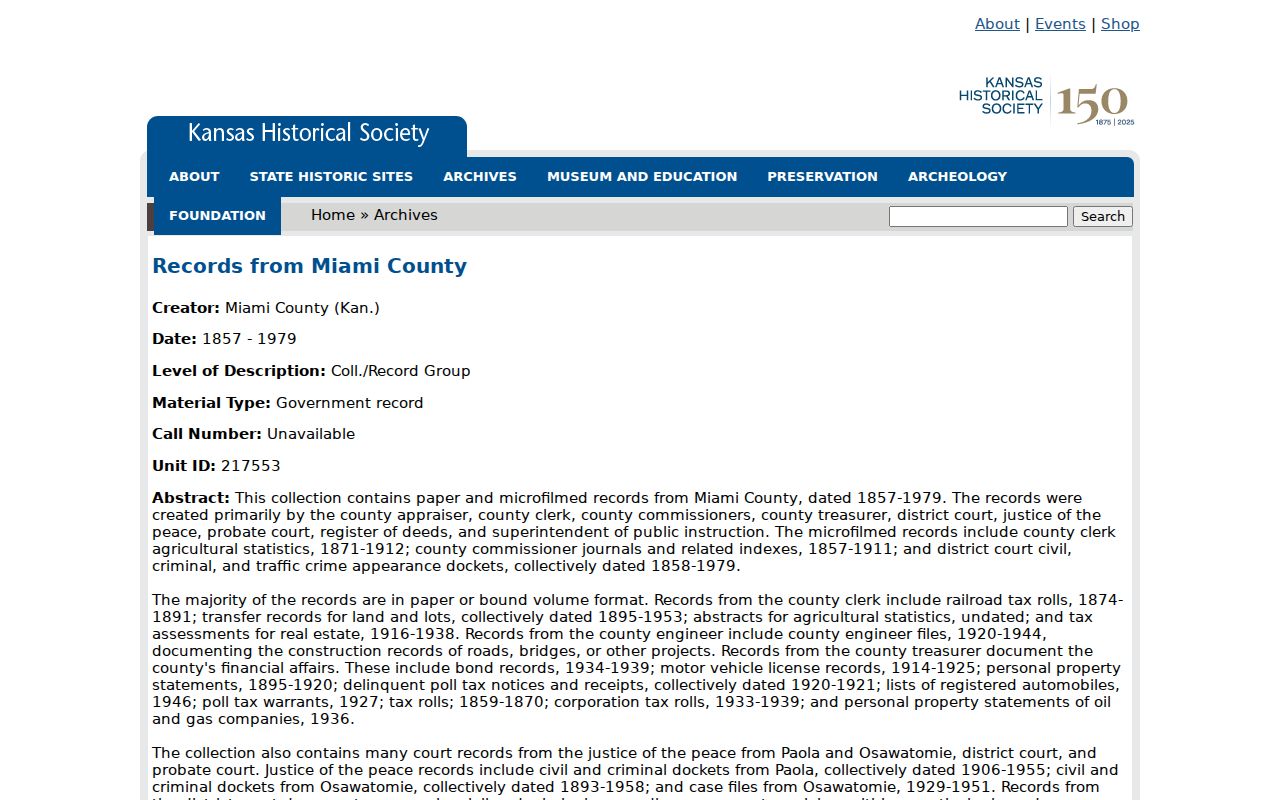
The collection record lists dates and creating offices, which helps when you frame a precise request for earlier owners of a Miami County parcel.
Bridge Probate and Foreclosure Gaps
A deed-to-deed chain can break. Estates, court orders, tax foreclosures, and sheriff's deeds all interrupt a clean ownership sequence. Track the case trail through Kansas CaseSearch. Rule 22 can block a guest result or document image. Ask the courthouse clerk for help when that happens. Sheriff sales run Wednesdays at 10:00 a.m. on the courthouse steps at 120 S Pearl Street in Paola. The county sells the properties as-is.
A foreclosure exhibit can still be gold. It may name the owner of record. It may also show the legal description, delinquent years, and the redemption amount. Remember that it is only a litigation snapshot. Check later deeds and releases before adding it to the ownership timeline.
Use Newspapers for Dates, Not Title Proof
The Kansas newspaper database turns up sheriff-sale notices, probate notices, subdivision announcements, road vacations, annexations, and old business or street names. Filter Paola, Louisburg, and Osawatomie titles by county and date range. A newspaper can explain why the next deed was recorded when the owner chain skips. It cannot prove title. Every event still needs confirmation in the recorder, court, clerk, or city archive. Only the official recording or case file establishes what actually changed hands.
Note: Keep the publication date and newspaper title beside the resulting official recording or case reference.
Distinguish Transfers From Related Instruments
Not every recording is a conveyance. A former-owner timeline collapses fast if mortgages, releases, and assignments all get treated as sales. Mortgages create security interests. Releases clear them. Assignments move a lender's interest, easements burden or benefit land, and plats simply describe geography. Record each document's stated role. Advance the owner chain only when the instrument or a controlling court record supports the transfer.
Deed forms matter too. Quitclaim and warranty deeds differ. A title alone never proves the grantor held everything being conveyed. Read the vesting clause, legal description, exceptions, and references before trusting a transfer. A recorded deed in Miami County property records is notice evidence, not a title opinion.
Preserve a Reproducible Former-Owner Trail
Save the search input, parcel number, instrument type and number, recording date, grantor, grantee, book/page, legal-description match, and image status for every link in the chain. Name files by parcel ID and record date, not by a person. Keep a gap log. It should state which official source came up empty and which custodian to contact next.
City archives make this discipline pay off. An annexation, de-annexation, street rename, or plat approval can explain why a modern parcel search misses an older owner. Miami County geography has shifted enough times to hide early tracts. The city action stays a geographic clue, though, until a recorded instrument or plat ties it to the land.
Request Older Miami County Volumes Precisely
Precision speeds up requests for older volumes. Give the Register of Deeds or KHS the last confirmed instrument, the parties, an approximate year, the subdivision or STR, and the book/page reference. Ask how the next index is arranged. Grantor, grantee, or numerical land description? Ask whether the image sits in a bound volume or on microfilm. For an estate gap, include the decedent and the rough probate period.
Miami County's genealogy page routes researchers to the courthouse, libraries, historical societies, and the museum. Those channels supply family and place-name context, while the recorded deed or court order remains the ownership evidence. Under KORA, offices may require a written request, advance payment, and actual production costs for a defined public record.
Trace Historic Miami County Geography Alongside Names
Geography shifts can hide an old deed. Miami County began as Lykins County in 1855. Jurisdiction or name changes often change how a parcel was cataloged. Keep former subdivision, town, street, and development names beside each party name you collect. Paola shows why this matters. Its annexation and de-annexation ordinances plus the Hidden Meadows Court street-name action carry a warning. A modern address alone can miss the earlier file.
Osawatomie records preserve place names such as Parkview East, Parkview West, Hickory Valley, Slayman Heights, Northland, Eastgate, Miller's, Robert's, Youman's, and J.C. Chestnut's. Treat every one as a clue until a plat confirms its legal role. Search city archives, historic newspapers, KHS land and lots indexes, and recorder descriptions. Then tie the result back to a lot and block or an STR description.
Handle a Missing Link as a Defined Research Gap
When the chain of ownership stops, describe the gap precisely. Record the last instrument and its date. Note every name variant searched, the legal description, the date range, and the document types involved. Note any portal limitation too. If Fidlar was inaccessible or the image was missing, ask recorder staff about the referenced volume. If KHS only describes a series, request a Reference Room consultation. A probate document missing from guest CaseSearch may sit with the district clerk. It may also be on a public terminal.
A negative online result proves nothing. It may reflect spelling, weak indexing, an unscanned volume, a name change, or restricted access. That does not mean the deed never existed. Preserving the reason keeps the ownership history reproducible. It also stops a gap from becoming an invented conclusion.
Know How Far Miami County Ownership Records Reach
When the chain of ownership stops, describe the gap precisely. Record the last instrument and its date, every name variant searched, the legal description, the date range, and the document types involved. Note any portal limitation too. Ask recorder staff about the referenced volume if Fidlar was inaccessible. Ask if the image was missing. If KHS only describes a series, request a Reference Room consultation. A probate document missing from guest CaseSearch may sit with the district clerk. It may also sit on a public terminal.
A negative online result proves nothing. It may reflect spelling, weak indexing, an unscanned volume, a name change, or restricted access rather than a deed that never existed. Preserving the reason keeps the ownership history reproducible. It also stops a gap from becoming an invented conclusion.
Online cutoff unknown. Miami County does not publish a complete historic Fidlar cutover; continue with the recorder, deed books, microfilm, or KHS rather than declaring the earlier chain absent.