
Miami County Deed Types
Miami County deed records held by the Register of Deeds reach back to the 1850s. The collection goes well beyond deeds. Mortgages, easements, mechanic liens, oil and gas leases and assignments, powers of attorney, surveys, subdivision plats, tax liens, and releases all sit in the same vault. Before searching, decide what legal act the document records.
| Deed Type | What It Does | Common Use |
|---|---|---|
| Warranty deed | Conveys an interest with stated covenants | Ordinary transfer research |
| Quitclaim deed | Conveys whatever interest the grantor holds | Corrective or family chain clues |
| Executor or trustee deed | Conveys through an estate or trust role | Probate and trust transfers |
| Sheriff's deed | Follows a judicial sale process | Court and sale research |
| Tax deed | Documents a tax-sale transfer | Delinquency chain research |
A deed and a lien can share an index page. They do very different work. A release or assignment may alter a lien interest while fee ownership stays untouched, so read the image and its prior-document references before labeling the event.
Miami County Uses Fidlar
The county's Register of Deeds page links two Fidlar services: Laredo for subscribers and Tapestry for pay-as-you-go access at any hour. Search keys include grantor, grantee, document number, date range, legal description, subdivision or metes-and-bounds text, and document type. Run party names and legal descriptions separately. Miami County cautions that not every legal description is indexed. For rural land, keep section, township, range, quarter, acreage, and metes-and-bounds clues handy. For platted land, search subdivision name and lot-block detail. Two passes often catch what one misses.
| Search field | Use | Caution |
|---|---|---|
| Grantor or grantee | Follow parties | Try variants |
| Document number | Exact instrument | Copy precisely |
| Date range | Narrow transfers | Use recording date |
| Legal description | Match land | Not fully indexed |
See Miami County Recorder Access
The official Register of Deeds page lays out the office's land-record duties, its contact route, and links to the Fidlar search services.
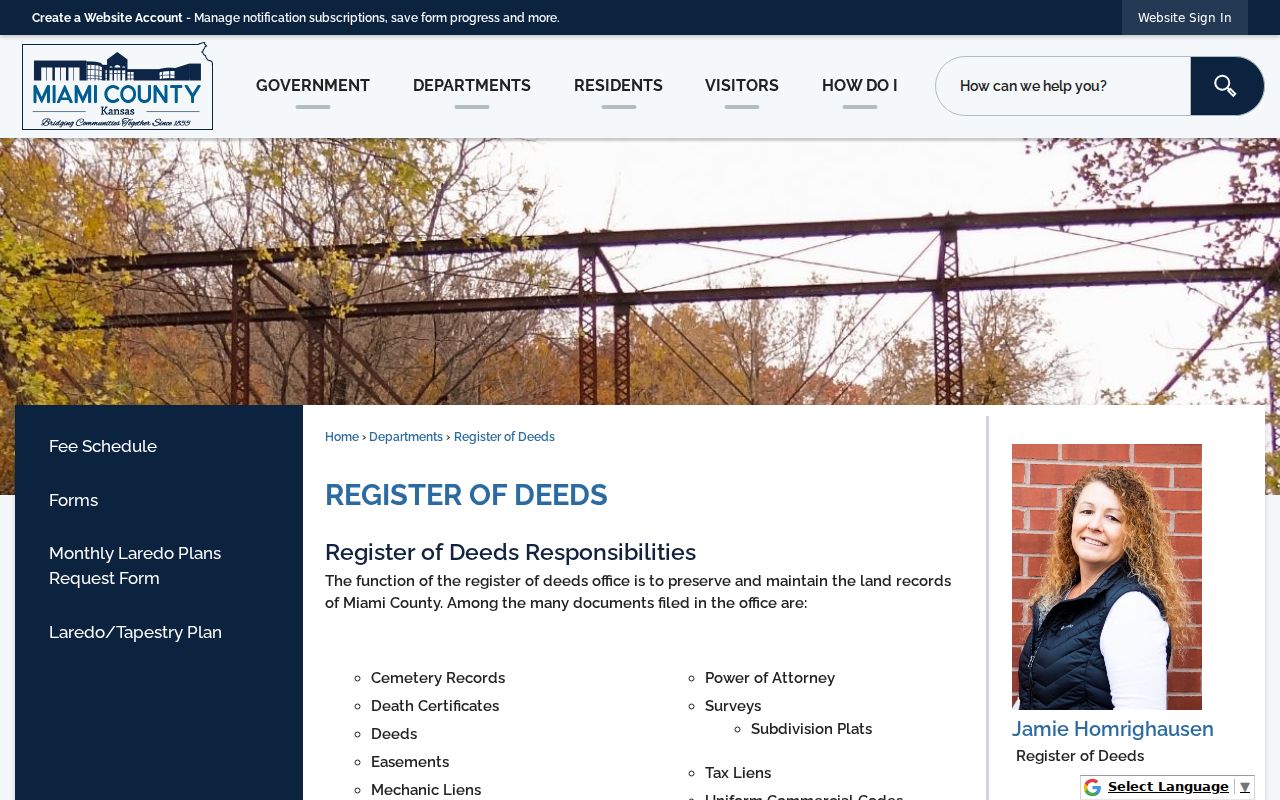
Start from the county's own description of its recorder services before choosing an online or in-office path. Go to the office directly when you need a certified image or have an older indexing question the remote tools leave open.
Miami Deeds Need Two Checks
A solid deed chain has to match people and land. Compare each grantor with the earlier grantee. Then compare the legal description, subdivision, lot, block, acreage, or rural calls across both instruments. A shared surname proves nothing without matching land. Matching land with a broken party path hints at a missing instrument. Probate orders, executor deeds, transfer-on-death instruments, and court decrees often explain the gap.
Search the recorder first. A recorded reference may point to a case. Kansas CaseSearch and the Miami County District Court's public terminal come next. Respect public-access limits along the way. What you build is a research chain, not a legal opinion. A title abstractor or attorney can weigh defects, unrecorded interests, and each instrument's legal effect.
Miami Plat Names Aid Deeds
A plat name often outlasts a family name. Recorded plats carry an approved subdivision name, lots and blocks, streets, easements, and dedication language. That name is worth searching in Fidlar. Beacon's subdivision field is another good spot. Try county planning files and a relevant city archive too. One match can bridge an old deed description and a modern parcel record.
Paola demands adjacent subdivision names and a county-wide nonduplicate name on final-plat materials. That makes a plat name a strong local clue. A mapped line may still sit wrong on the ground. Compare the recorded plat against the deed before trusting any boundary call. Surveyors settle those questions.
Miami Deed Access Boundaries
Most recorded land instruments in Miami County are public. The Register of Deeds closes two categories: Real Estate Sales Validation Questionnaires and military discharges. The office also posts a K.S.A. 45-230 warning. It covers knowingly using, selling, or receiving name-and-address lists to peddle property or services.
When an open item never surfaces in the remote index, request it by instrument type, parties, date span, parcel, and legal description. Kansas law allows inspection and copies at actual cost, subject to exemptions. If part is withheld, ask for the statutory basis. Also ask for the segregated open portions.
Images Add Miami Deed Facts
An index result gives you instrument number, date, document type, grantor, grantee, legal text, subdivision, lot, block, and an image reference. The image adds what the index cannot. Look there for execution date, consideration, tax stamps, marital status, notary details, exhibits, covenants, easement locations, mineral reservations, survivorship terms, and prior references. Never promote a name from index to owner of record. Read the instrument and compare the chain first. A big-looking release may change no ownership. Note the index fact and the image fact separately.
Historic Miami Deed Indexes
The Kansas Historical Society holds deep Miami County deed material. Its catalog lists deed indexes spanning 1859 to 1985. Numerical land and city-lot indexes run from 1858 to 1939. Mortgage indexes cover 1911 to 1917, and chattel-mortgage series run across several decades. Most of it is paper or microfilm for Reference Room use.
Use these when the remote index stops short. Pin down the series and date span first. Then ask the Reference Room staff to pull the right roll or volume. A catalog hit only points to the volume.
Miami County Grantor-Grantee Chain
A grantor gives up an interest in land. The grantee receives it. To follow a Miami County deed records chain, start with the most recent transfer you know and treat each grantor as the grantee in the next older deed. Matching the legal description at every step keeps you from confusing two people who share a name.
- Find the newest deed with the current party as grantee.
- Read its grantor, recording date, legal description, and prior reference.
- Search that grantor as an earlier grantee and compare the same land.
- Repeat until the remote index ends, then move to deed books or microfilm.
- Grantor
- The party transferring an interest.
- Grantee
- The party receiving an interest.
- Chain of title
- The ordered sequence of recorded transfers for land.
- Instrument number
- A unique recording reference, distinct from a book and page citation.
Miami County Deed Fees
The county fee schedule sets copy pages at $1 apiece and plats at $3. Recording any deed, mortgage, or similar instrument runs $21 for the first page. Each page after that costs $17. A mortgage release or assignment carries a $20 first-page charge. The Fidler plan adds $8.75 for a Tapestry index and image search. It also adds $1 per printed page. Search, copy, and recording fees are separate charges. Check with the recorder for current costs and any certification fee before ordering.
Miami County Fraud Alerts
Property Fraud Alert sends a free phone or email notice when a name you register shows up in recording activity. It is an early warning, nothing more. It is not title insurance, and it does not prove fraud happened. Treat any alert as a prompt to pull the actual recorded document from the deed records. Compare parties, legal description, signatures, and prior references. Contact the right institution if the filing looks unfamiliar.
Order a Miami County Deed
The Tapestry image works well when remote access is enough. For a plain or certified copy of a Miami County deed, give the Register of Deeds the instrument number or book-page reference. Include the recording date, the parties, and the legal description too. The office sits at 201 S Pearl, Suite 101, in Paola. It lists 913-294-3716 and rod@miamicountyks.gov. Confirm the delivery method and certification fee before sending payment.
When an older deed is missing online, ask the recorder about it. The Kansas Historical Society may hold the volume instead. A specific request beats asking for every record tied to a name.
Recorded, not guaranteed. Miami County deed records show filed instruments. They do not resolve every unrecorded interest or provide a legal title opinion.